Working Group and Report
In August of 2015, Georgetown University launched a new effort to reflect on, engage with, and learn from its historical ties to slavery. The Working Group on Slavery, Memory, and Reconciliation, comprised of students, faculty, staff, and alumni, was appointed and charged by then-President John J. DeGioia in September to study and make recommendations to help guide the University’s ongoing work related to slavery and its legacies.
The Working Group built upon and brought additional focus to earlier modern scholarship into the history of Georgetown, the Jesuits, and enslavement. These included the Jesuit Plantation Project, an early digital humanities effort launched by Georgetown’s Department of American Studies in the 1990s, which made archival materials available online. Other contributions to this historical research are included in the Further Reading resources.
In November of 2015, the Working Group made its first formal recommendation to the University, recommending the interim renaming of Mulledy Hall and McSherry Hall as Freedom Hall and Remembrance Hall to allow for more dialogue before further naming recommendations. This recommendation was accepted by the University. The Working Group continued to solicit input from the community as it developed its report and recommendations. These buildings were formally renamed Isaac Hawkins Hall and Anne Marie Becraft Hall in a ceremony in April 2017.
The Report of the Working Group on Slavery, Memory, and Reconciliation was completed in the summer of 2016.
Then-president DeGioia, along with the members of the Working Group, shared the report with the Georgetown community on September 1, 2016. Georgetown’s ongoing work to acknowledge and respond to its history is directly shaped by the Working Group’s recommendations, as well as new ideas and projects that have emerged in collaboration with Descendants, faculty, and students.
Related Content
Ongoing Work in Slavery, Memory, and Reconciliation
Descendant Engagement
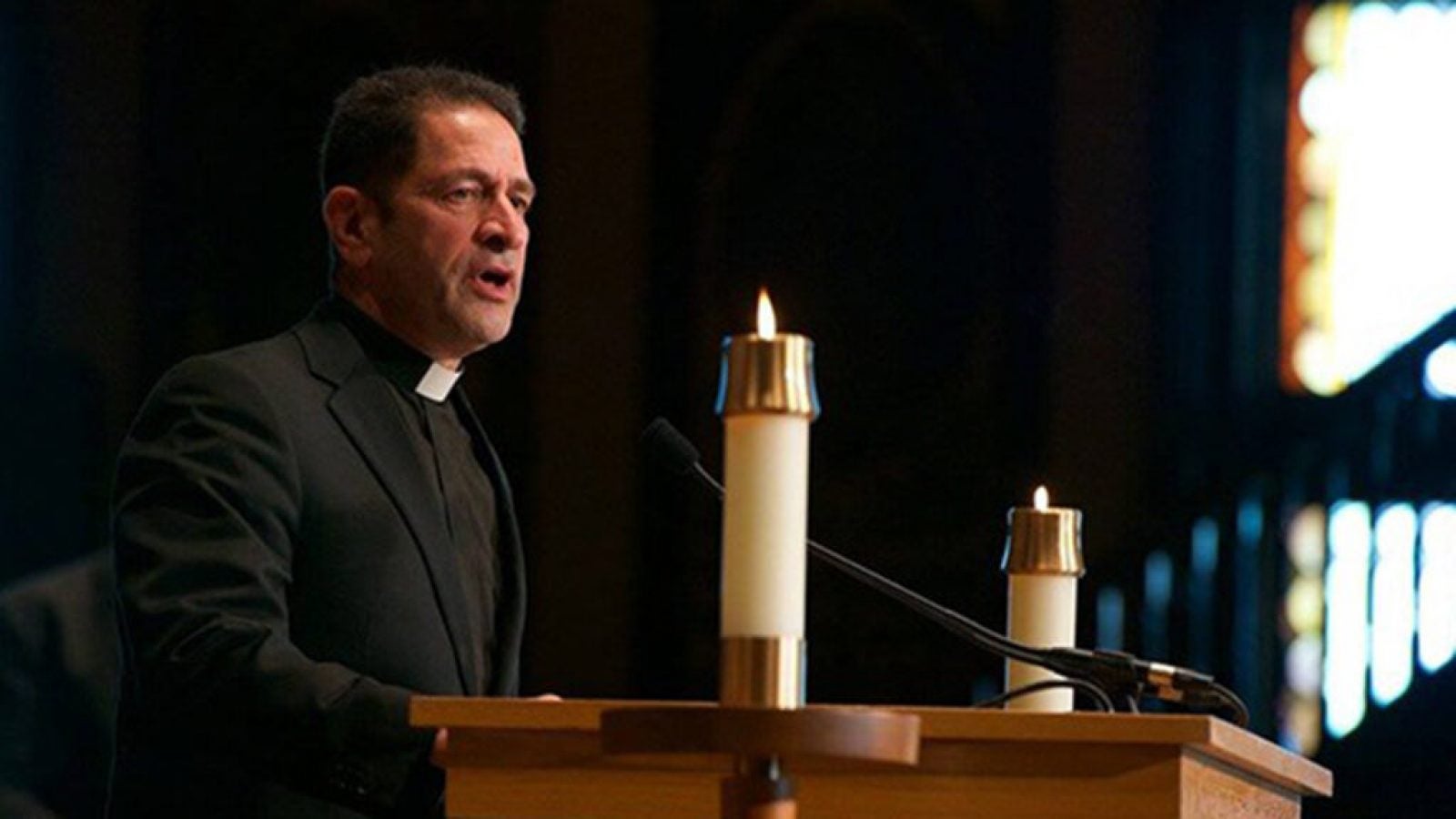
In April of 2017, Georgetown held a special Liturgy of Remembrance, Contrition, and Hope in partnership with the Society of Jesus and the Archdiocese of Washington. At this Liturgy, the University and the Society of Jesus offered an apology for the 1838 sale of 272 enslaved children, women, and men. On the same day, the University also dedicated two buildings on the Hilltop campus: Isaac Hawkins Hall and Anne Marie Becraft Hall. More than 100 Descendants attended these gatherings.
The University has met with many members of the Descendant community whose Ancestors were enslaved on Maryland Jesuit plantations in the 18th and 19th centuries, and has been honored to engage together on collaborative efforts, including the Reconciliation Fund and Descendants Truth and Reconciliation Foundation. Since 2016, members of the Descendant community have also joined Georgetown academic programs through an admissions consideration policy recommended by the Working Group.
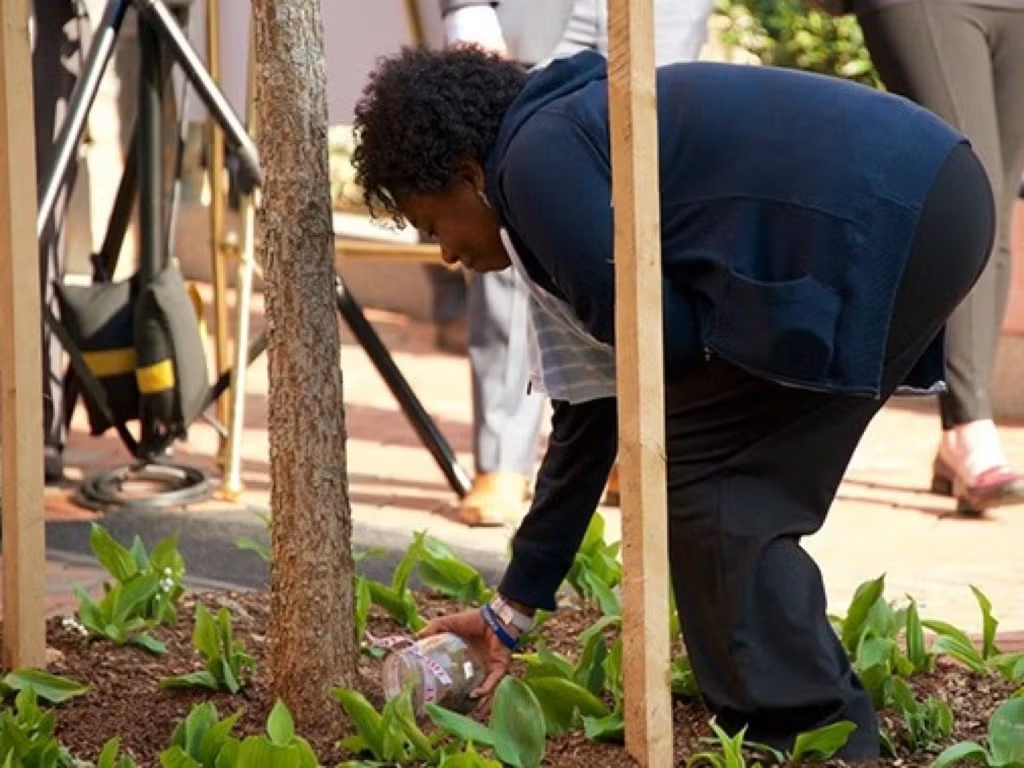
Descendant Jessica Tilson covers the roots of the white oak tree, planted at Georgetown in 2017 in honor of the more than 270 enslaved individuals and their descendants, with soil from the old West Oak Plantation in Louisiana.
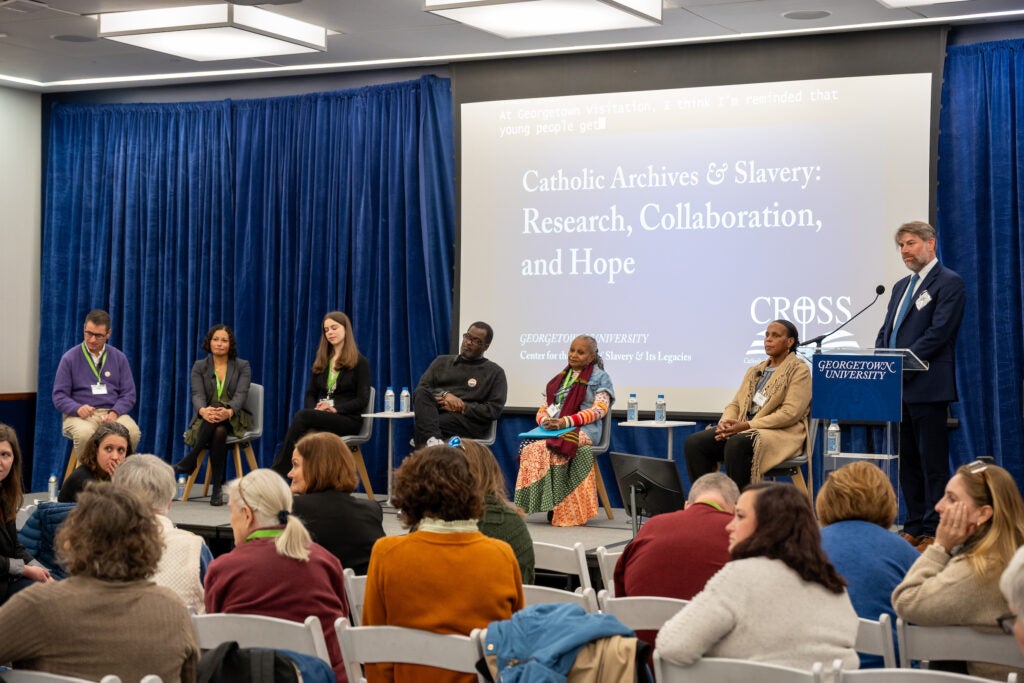
Reconciliation Fund awardees and educators participate on a panel about innovative pedagogical projects as part of the Catholic Religious Organizations Studying Slavery (CROSS) Conference 2025.
Academic and Research Initiatives
Georgetown’s ongoing work to research, digitize, and share the history of slavery and segregation included the formation of the Georgetown Slavery Archive in 2016 (by the Working Group’s Archives Subgroup), and work by the Georgetown Libraries to enhance access to essential resources, further develop its collections, and promote these resources in the classroom and among researchers. In 2015, Georgetown joined Universities Studying Slavery (USS), now an international consortium of over one hundred institutions of higher education committed to research, acknowledgment, education, and atonement regarding institutional ties to enslavement. Georgetown has twice hosted the USS semi-annual conferences.
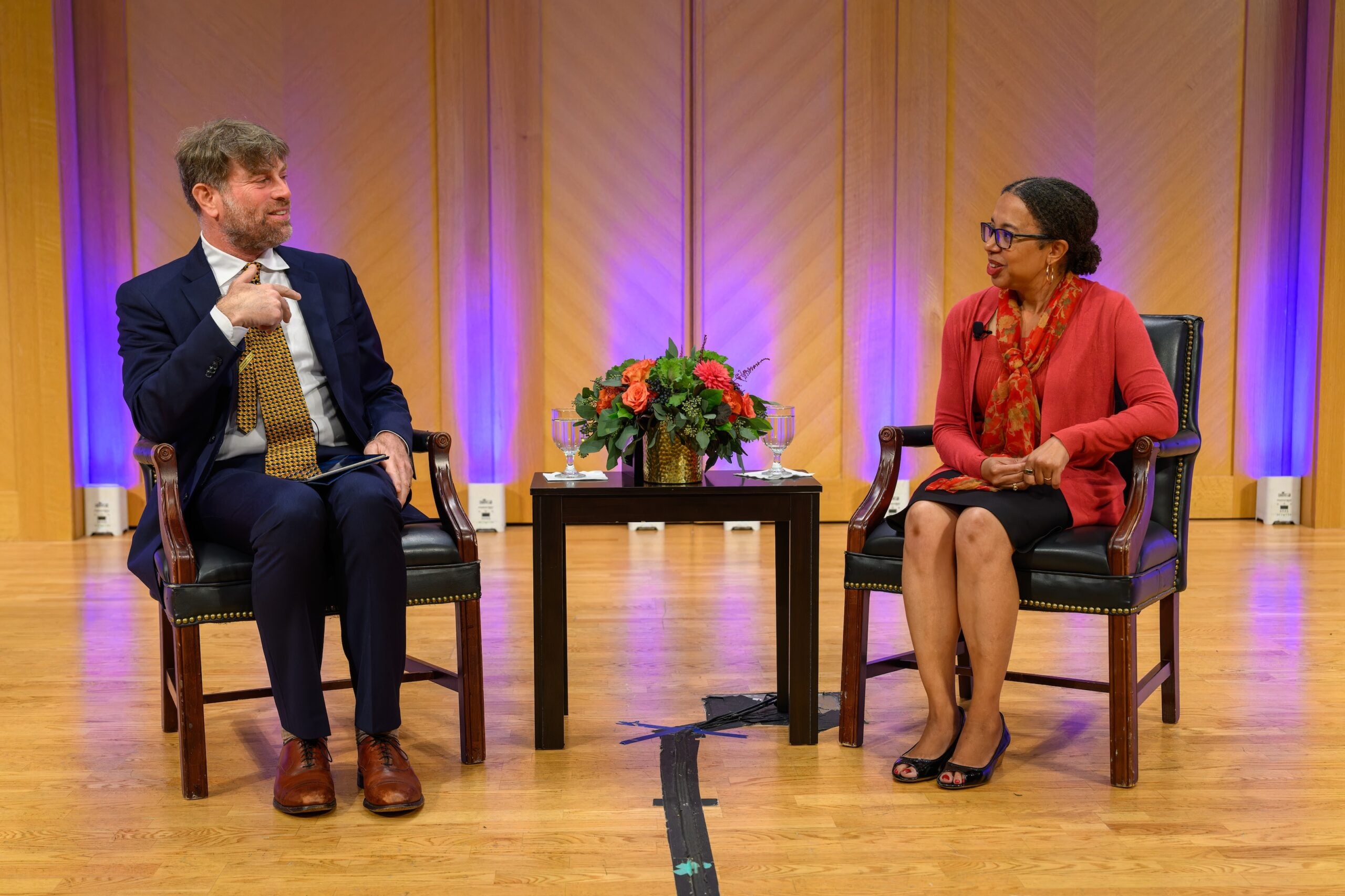
Georgetown’s goal to support all of these efforts reached an important milestone in 2023 with the launch of The Center for the Study of Slavery and Its Legacies, now a home to academic and research initiatives connected to Georgetown’s ongoing commitments in Slavery, Memory, and Reconciliation. Among its projects, the Center has developed modules on Georgetown’s history that are incorporated into the required, one-credit undergraduate University Seminar, hosted visiting scholars for events, and promoted collaboration across the university, and between the university community, the Descendant community, and the broader public, to understand this important history and its meaning today.
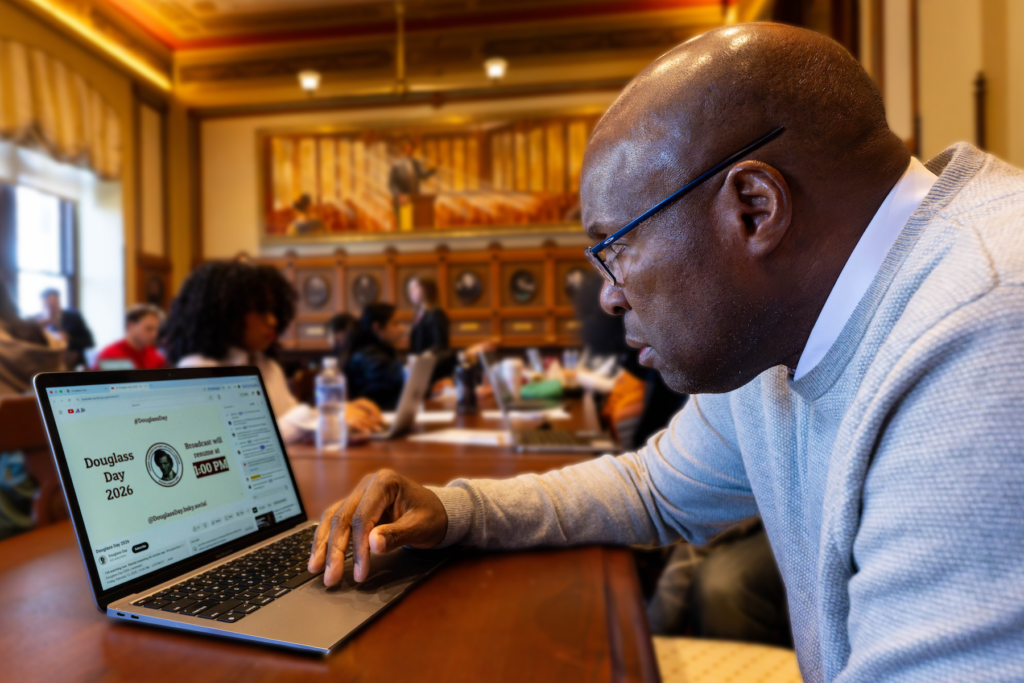
Douglass Day 2026 Community Transcription Event.
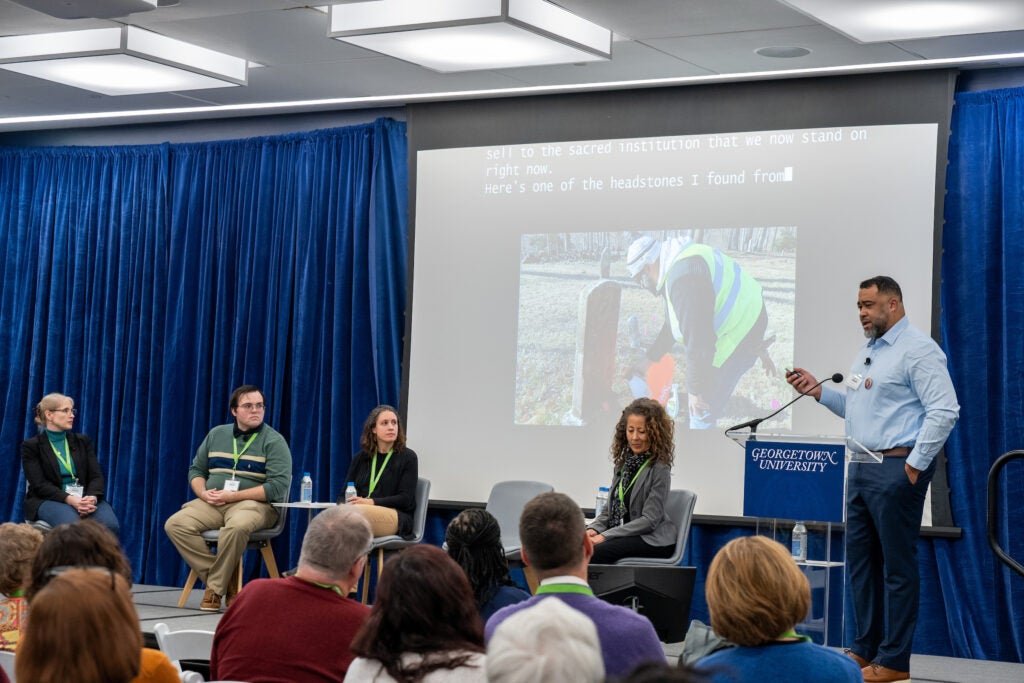
Descendants and researchers present their work on “Understanding Catholic History and Catholic Cemeteries through Archaeology” as part of the Catholic Religious Organizations Studying Slavery (CROSS) Conference 2025.
Public History and Memorialization
As research continues to uncover and clarify Georgetown’s historical connections to enslavement, concurrent efforts strengthen our community’s institutional memory through public history and memorialization. Two buildings formerly named for architects of the Jesuits’ 1838 sale of enslaved individuals were renamed for Isaac Hawkins and Anne Marie Becraft. Georgetown has also collaborated with Holy Trinity Church for improvements and maintenance of Holy Rood Cemetery, and partnered with students in examination of historic campus spaces. The Leavey Center is home to a digital installation that incorporates the names of those who were enslaved into this hub of the Hilltop campus.
In 2019, students in Professor Adam Rothman’s class researched buildings and sites on Georgetown’s campus to provide historical context for understanding their significance. This Walking Tour of Slavery, Memory, and Reconciliation, developed by the Georgetown University Library’s Booth Family Center for Special Collections, allows anyone to tour these historic sites, either on campus or virtually. A student-led video production of the campus walking tour was developed for New Student Orientation, and the Center for the Study of Slavery and Its Legacies hosts an in-person tour of these sites as part of annual programming to commemorate D.C. Emancipation Day each April.
Georgetown has also pursued a related set of efforts to strengthen the University’s commitment to racial justice with the creation of the Department of African American Studies in 2016 (now the Department of Black Studies), the hiring of new faculty, and creation of the Racial Justice Institute.
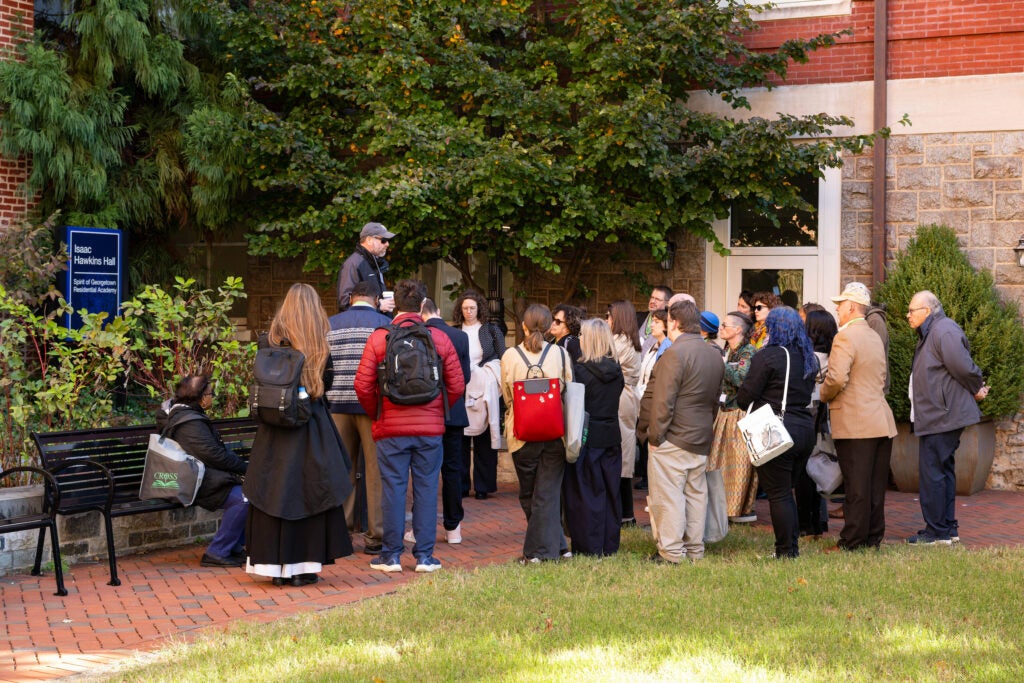
Professor Adam Rothman leads a walking tour of Slavery, Memory, and Reconciliation on the Georgetown campus.
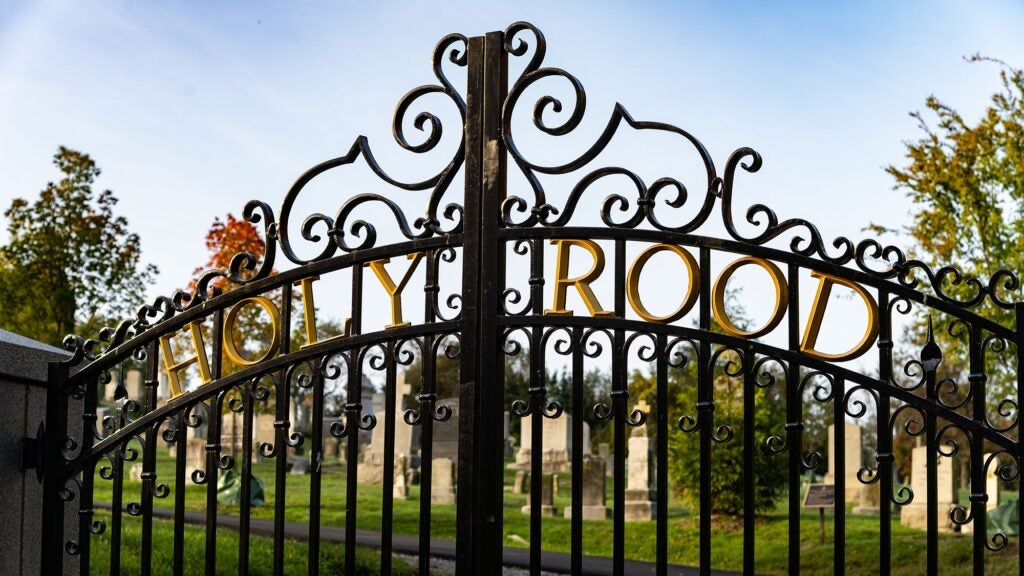
Holy Rood Cemetery, located near the Georgetown University Hilltop campus in Washington D.C.
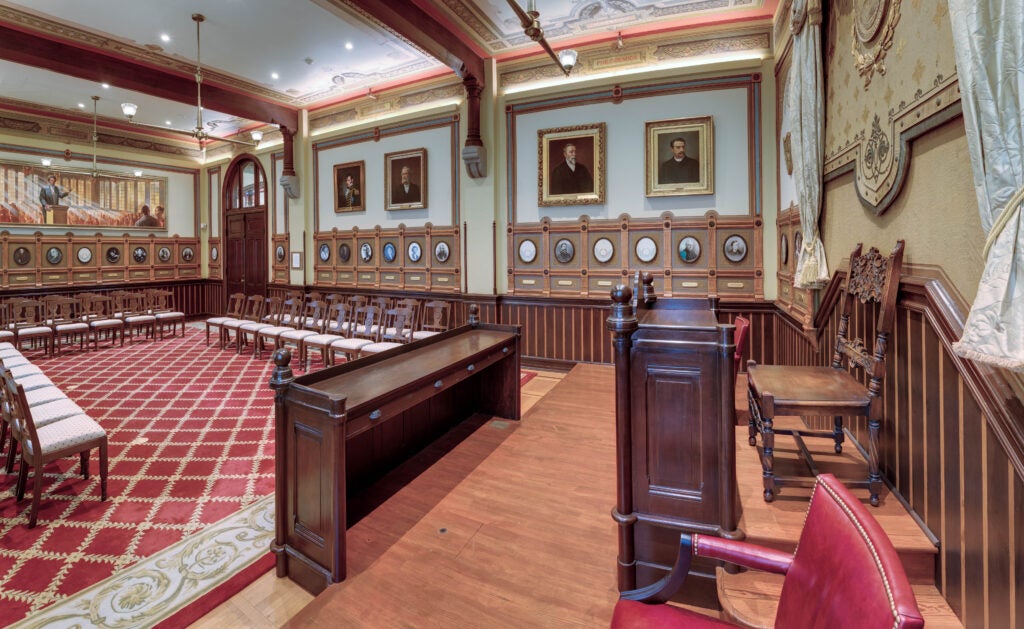
The Philodemic Room in Healy Hall, located on Georgetown’s Hilltop campus.
Featured Videos
Further Reading
- Beckett, Edward. S.J. “Listening to Our History: Inculturation and Jesuit Slaveholding.” Studies in the Spirituality of Jesuits 28/5 (November 1996): 1-48.
- Berlin, Ira. “American Slavery in History and Memory and the Search for Social Justice.” The Journal of American History 90 (2004): 1251-1268.
- Clarke, Max and Gary Alan Fine. “‘A’ for Apology: Slavery and the Collegiate Discourses of Remembrance – the Cases of Brown University and the University of Alabama.” History and Memory 22 (2010): 81-112.
- Collins, David. “Georgetown, Jesuits, Slaveholding.” The Hoya February 9, 2015. Web.
- Collins, David J. The Jesuits in the United States: A Concise History. Washington, D.C.: Georgetown University Press, 2023.
- Curran, Robert Emmett. “Building a College and More.” In The Bicentennial History of Georgetown University: From Academy to University, 107-130. Washington: Georgetown University Press, 1993.
- Curran, Robert Emmett. “‘Splendid Poverty’: Jesuit Slave Holdings in Maryland, 1805-1838.” In Catholics in the Old South. Edited by Randall M. Miller and Jon L. Wakelyn. Macon, Georgia: Mercer University Press, 1983.
- Endres, David J., Editor. Black Catholic Studies Reader: History and Theology. Catholic University of America Press, 2023.
- Endres, David J., Editor. Slavery and the Catholic Church in the United States: Historical Studies. Catholic University of America Press, 2023.
- Gollar, C. Walker. Let Us Go Free: Slavery and Jesuit Universities in America. Georgetown University Press, 2023.
- Jackson, Maurice. “Washington, DC: From the Founding of a Slaveholding Capital to a Center of Abolitionism.” Journal of African Diaspora Archaeology & Heritage 2.1 (May 2013): 40-66.
- Kellerman, Christopher J., S.J. All Oppression Shall Cease: A History of Slavery, Abolitionism, and the Catholic Church. Orbis Books, 2022.
- Kolchin, Peter. “Slave Life” and “The White South.” In American Slavery, 1619-1877, 133-199. New York: Hill and Wang, 1993.
- Macgregor, Morris. The Emergence of a Black Catholic Community: St. Augustine’s in Washington. 1999.
- Menzie Lesko, Kathleen, Valerie Babb, and Carroll R. Gibbs. Black Georgetown Remembered: A History of Its Black Community From the Founding of “The Town of George” in 1751 to the Present Day. Washington, DC: Georgetown UP, 2016.
- Preface and Chapter 1 recommended
- See details on the event celebrating the book’s 25th anniversary
- Murphy, Thomas, S.J. Jesuit Slaveholding in Maryland, 1717-1838. Studies in African American History and Culture. New York: Routledge, 2001.
- Quallen, Matthew. “Beyond the 272 Sold in 1838, Plotting the National Diaspora of Jesuit-Owned Slaves.” The Hoya April 30, 2016. Web.
- Quallen, Matthew. “Georgetown, Financed by Slave Trading” The Hoya September 26, 2014. Web.
- Quallen, Matthew. “Jesuit Ideals Facing the Slave Trade.” The Hoya January 16, 2015. Web.
- Quallen, Matthew. “Slavery Inextricably Tied to Georgetown’s Growth.” The Hoya October 23, 2015. Web.
- Quallen, Matthew. “Slavery’s Remnants, Buried and Overlooked.” The Hoya September 11, 2015. Web.
- Rothman, Adam and Elsa Barraza Mendoza, Editors. Facing Georgetown’s History: A Reader on Slavery, Memory, and Reconciliation. Georgetown University Press, 2021.
- Swarns, Rachel. The 272. Penguin Random House, 2024.
- Wilder, Craig Steven. Ebony and Ivy: Race, Slavery, and the Troubled History of America’s Universities. New York: Bloomsbury Press, 2013.
- Wilder, Craig Steven (2016). War and Priests: Catholic Colleges and Slavery in the Age of Revolution. In S. Beckert & S. Rockman (Eds.), Slavery’s Capitalism: A New History of American Economic Development. University of Pennsylvania Press.